If you’ve been thinking about selling, you’ve probably seen plenty of headlines suggesting buyers have just about disappeared. But there’s a big difference between a slow market

Dated: January 15 2026
Views: 17

It’s hard to scroll online lately without seeing some version of this claim:
“Big investors are buying up all the homes.”
And honestly, if you’re a homebuyer who’s lost out on a few offers, that idea probably sounds believable. When homes are expensive and competition is tight, it’s easy to assume giant companies are scooping everything up behind the scenes.
But here’s the thing: what people assume is happening and what the data actually shows aren’t always the same.
Let’s look at what’s really happening with large institutional investors in today’s housing market – because the numbers tell a much different story than the headlines.
Let’s start with the most important stat. According to John Burns Research & Consulting (JBREC), large institutional investors – those that own 100 or more homes – made up just 1.2% of all home purchases in Q3 of 2025 (see graph below):
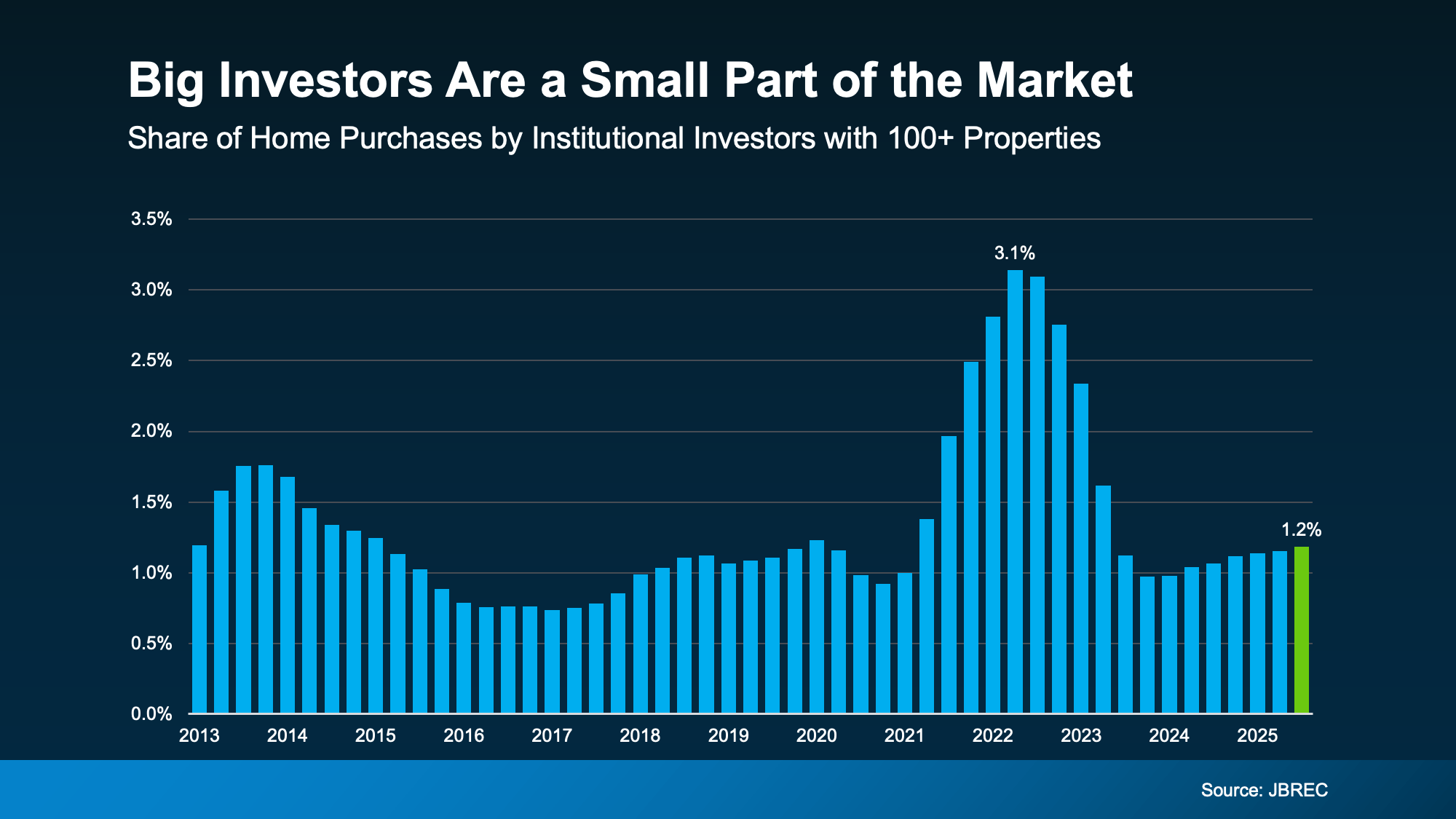 That’s it. Out of every 100 homes sold, only about 1 went to a large institutional investor.
And here’s an important point that often gets missed: that level of investor activity is very much in line with historical norms. It’s not unusually high, and it’s actually well below the recent peak of 3.1% back in 2022 – which itself was still a small share of the overall market.
So, while it can feel like big investors are everywhere, nationally, they’re a very small part of overall home sales.
There are two main reasons this topic gets so much attention:
Yes, big investors exist. Yes, they buy homes. But nationally, they’re responsible for a very small share of total purchases – far smaller than most people assume.
The bigger challenges around affordability have much more to do with supply, demand, and years of underbuilding than with large institutions competing against everyday buyers.
That’s why it’s so important to separate noise from reality, especially if you’re trying to decide if now is the right time to move.
If you want to talk through what investor activity actually looks like in our local market, and how it impacts your options (or doesn’t), let’s connect.
Sometimes a little context makes all the difference.

I've dedicated my real estate career with connections to our "Heroes". Who are our Heroes? Those in the professions of the US Military, Police, Fire, Education, Medical, and Social Services, who self....
If you’ve been thinking about selling, you’ve probably seen plenty of headlines suggesting buyers have just about disappeared. But there’s a big difference between a slow market
If the first half of this year has left you feeling stuck, you’re not the only one. Mortgage rates stayed higher than people wanted. Affordability remained tight. And uncertainty overseas
Buying or selling a home is a big financial decision. And right now, it feels even bigger. Inflation is high, costs are high, and you want to be sure the timing is right before you make your move.
Saving for a down payment can feel like the hardest part of buying a home. And with affordability as tight as it’s been lately, it’s fair to wonder how anyone manages it right now. Here
 Based on information from California Regional Multiple Listing Service, Inc. as of September 27, 2026 8:12 AM UTC This information is for your personal, non-commercial use and may not be used for any purpose other than to identify prospective properties you may be interested in purchasing. Display of MLS data is usually deemed reliable but is NOT guaranteed accurate by the MLS. Buyers are responsible for verifying the accuracy of all information and should investigate the data themselves or retain appropriate professionals. Information from sources other than the Listing Agent may have been included in the MLS data. Unless otherwise specified in writing, Broker/Agent has not and will not verify any information obtained from other sources. The Broker/Agent providing the information contained herein may or may not have been the Listing and/or Selling Agent.
Based on information from September 27, 2026 8:12 AM UTC The information being provided by CRMLS is for the visitor's personal, noncommercial use and may not be used for any purpose other than to identify prospective properties visitor may be interested in purchasing. The data contained herein is copyrighted by CRMLS, CLAW, i-Tech MLS, PSRMLS and/or VCRDS and is protected by all applicable copyright laws. Any dissemination of this information is in violation of copyright laws and is strictly prohibited.
Any property information referenced on this website comes from the Internet Data Exchange (IDX) program of CRMLS. All data, including all measurements and calculations of area, is obtained from various sources and has not been, and will not be, verified by broker or MLS. All information should be independently reviewed and verified for accuracy. Properties may or may not be listed by the office/agent presenting the information.
